Janet Murray
Clown in a CornfieldJanet Murray is a socially assured, media-savvy teenager in Kettle Springs whose instinct to record events places her at the edge of both spectacle and danger. She helps make local life visible through a youth video channel, but the story repeatedly turns the camera’s promise of control inside out: recordings can miss the decisive action, while a live audience may recognize a catastrophe before those present do.
Identity and Social Bearing
Janet first comes into focus through her ease with other people and her attention to how they appear. At a reservoir gathering, she calls after Ginger Wagner as Ginger rolls by on a skateboard, then follows her with a camera and urges her to perform. The request turns a risky stunt into content: Ginger launches over the low concrete barrier and drops toward the water, board and all, while Janet thinks about saving the opening seconds for a later post. Her instinct is not simply to watch the event but to frame it for an audience.
At school, that confidence takes a more orderly form. During Mr. Vern’s class, Janet challenges a discrepancy in the syllabus: the first exam is supposed to cover nutrition, yet the class has not reached that material. She has brought a large, carefully organized three-ring binder and points out that nutrition is chapter twelve, asking whether students are expected to read out of order. The scene presents her as prepared and willing to make a teacher answer for the written plan, even when other students react with sighs and scoffs.
Janet’s standing among her peers is not defined by deference to the boys around her. When Quinn Maybrook asks about the group’s channel, Janet explains that it featured stunts and pranks, had nearly six thousand subscribers, and had videos approaching fifty thousand views. She corrects herself from speaking of the channel in the present to acknowledging that it may be finished, then directs a withering look at Cole Hill. Quinn notices that, unlike Ronnie Queen and Tucker Lee, Janet does not seem to be under Cole’s thumb, and likes that independence.
Cameras, Performance, and Public Life
The channel’s online reach makes recording a recurring part of Janet’s social world. When students discuss Mr. Vern’s outburst, Janet asks Ronnie whether she caught any of his rant on video. Ronnie says she was not filming; Cole Hill responds that missing it has left them in their present predicament. Janet’s question treats the camera as a means of preserving and circulating an event, while the exchange also shows that recording is not automatic: a moment can pass without becoming footage.
That tension is stark at the reservoir. After Victoria Hill surfaces face down with her arms out, Janet drops Cole Hill’s phone. The live feed continues to show the sky and carry voices, including screams, but not Cole’s dive, his effort to bring his sister to shore, or the wound at the back of her head. The comments identify the death while the people at the scene are still confronting what happened. The phone preserves sound but fails to show the action that would explain it; Janet’s earlier excitement about capturing a stunt is set against a recording that cannot make a fatal event fully visible.
On Founder’s Day, Janet moves through the parade’s overlapping performances with a similar awareness of audience and image. She wears a thin cardboard half-mask fashioned after Frendo, with a paper clown nose and eyes that do little to disguise her face. She remarks to Quinn that Tucker Lee is unusually enthusiastic in costume, then slips her hand into the crook of Quinn’s arm. The gesture is familiar, but Quinn does not pull away. Nearby, Tucker wears a more elaborate, aged Frendo mask and full jumpsuit, making the contrast between the two costumes conspicuous.
The parade also brings Janet’s family into view. A woman seated as queen beside a costumed Frendo wears the Miss Kettle Springs sash and resembles Janet closely; Ronnie Queen’s live narration identifies her as Janet’s mother. While Ronnie films herself and the parade, Janet has her own phone out. Quinn sees a single word on its screen: Go. Janet tells Ronnie to keep the camera on the parade, directing the footage away from whatever Ronnie had been preparing to expose. The moment links Janet’s awareness of filming to a silent, precisely timed cue rather than a public confrontation.
From Spectacle to Immediate Danger
The distance between performance and peril collapses during the attacks. When Quinn is holding the wounded Ginger Wagner, Janet approaches carrying two Solo cups and begins to offer one. Seeing Ginger, she drops both drinks and screams; beer splashes onto the dirt, dead grass, and Quinn’s cheek. The dropped cups make her shock physical and immediate. In this scene, Janet is no longer arranging an image for viewers: she is confronted with an injured friend and cannot keep the ordinary social gesture of offering a drink intact.
Later, Janet cries that someone is trying to kill her and asks why she has been singled out. She changes direction and speeds up, running in a jerky burst through the crowd; in her path, she shoves a boy so young he appears to be a freshman, sending him sprawling. The flight is chaotic, and her attempt to escape has a direct cost for another student. The narrative does not turn her into a composed action hero; it shows a frightened person moving at speed through a stampede.
When Quinn recognizes Ruston Vance emerging from the darkness and corn, she wants to throw herself into her neighbor’s arms but cannot because she is the only thing keeping Janet on her feet. Janet still finds room for a dry remark about the arrival of the Mounties. The quip does not remove the danger or establish that she is unharmed; it shows that even while dependent on Quinn for support, she retains the irreverent voice evident in her earlier exchanges.
Memory, Resolve, and the Clown Attacks
A remembered insult helps explain Janet’s hard-edged self-presentation without reducing her to it. Nearly fifteen years earlier, a classmate told her she was not from around there. Janet recalls the boy as Tom Mathers and remembers ruining his clothes, making him cry on the playground, and later spreading a rumor that he was responsible for the school’s lice screening. She understands those incidents as part of how she made her way in Kettle Springs: she remembers what people said and does not care about them in return. The recollection connects her confidence to an older experience of being marked as an outsider, while also showing that she answered exclusion by humiliating others.
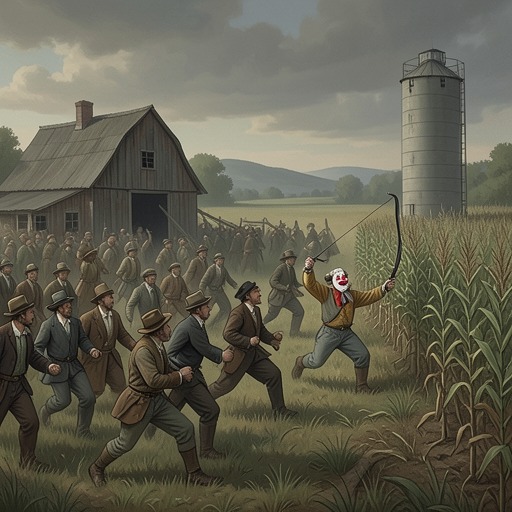
During the attacks, that same self-belief becomes a practical calculation. From a hiding place, Janet considers whether she can outrun the figure in combat boots and whether she can kill him; she then imagines that she might save everyone. When she finds her voice, she yells for people to get back and run, warning them that there is more than one clown. The sequence matters: private assessment becomes a public warning. Janet’s actions do not establish that she can protect everyone, but they show her recognizing a wider threat and trying to keep others from treating the danger as a single pursuer.
Janet’s role is shaped by the contrast between mediated and immediate experience. She has helped turn stunts, school confrontations, and parade moments into material for an online audience, yet the reservoir livestream demonstrates how a camera can record the wrong part of a crisis. In the attacks, her most consequential contribution is not a successful recording but a shouted warning. Her confidence, memory of local exclusion, and fluency with performance persist under pressure, though the scenes also expose their limits: an audience cannot substitute for help, bravado cannot guarantee safety, and a person accustomed to directing the frame may still be caught inside events she cannot control.